ADVOCACY

Challenging the Four Pillars of Claims Failure

We demand clear communication, dignity, active participation, and financial stability for every worker.

The current framework measures success by bureaucratic compliance rather than human recovery. IWST actively challenges system failures across four critical areas:

WHY REFORM

Challenging the Four Pillars of Claims Failure

Challenging the Four Pillars of Claims Failure
The current framework measures success by bureaucratic compliance rather than human recovery. IWST actively challenges system failures across four critical areas

01

Communication

Ending toxic delays and ambiguous decisions.

02

Dignity & Respect

Ensuring workers are treated as partners in recovery, not subjects of scrutiny.
03

Worker Agency

Fighting for your right to be actively involved in treatment decisions.
04

Financial Security

Protecting families from sudden benefit cuts and housing instability.

A Framework, Not a Finding

The Cycle of Administrative Harm

One pressure feeds the next. This sequence describes how exposure inside the system can compound over the life of a claim.

1

Workplace injury or illness

2

Claim submitted

3

Uncertainty about entitlement or treatment

4

Repeated administrative and medical demands

5

Poor communication or delayed decisions

6

Loss of control and participation

7

Financial, employment or housing pressure

8

Psychological deterioration

9

More complex treatment and extended recovery

10

Further disputes and escalation

This is a framework for understanding and testing the relationship between system exposure and outcomes. It is not proof of causation. It is offered as a model that policymakers, regulators and researchers can examine, measure and test against real claims data.

Parliament of Victoria

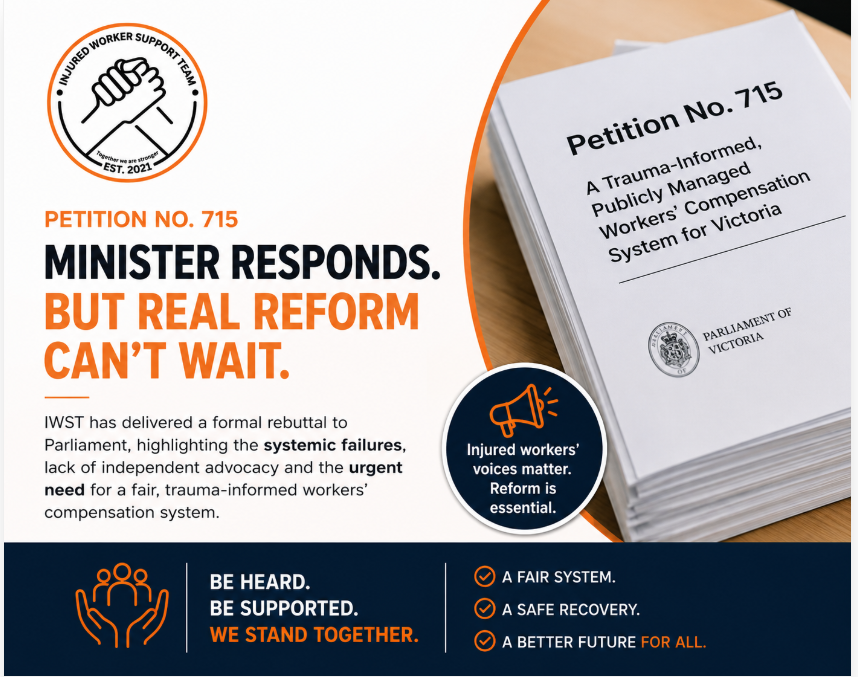
Petition No. 715

A Trauma-Informed, Publicly Managed Workers’ Compensation System for Victoria
Legislative Council Petition No. 715 asks Parliament to look past the question of whether legislation exists. IWST’s formal rebuttal to the Minister’s response makes the same argument: the test of a compensation system is not the presence of rules, but whether it delivers fair, safe and trauma-informed outcomes for the injured workers who depend on it.
[Document link to be supplied by the client]


The harm no one sees is real.

It’s time the system finally saw it.